
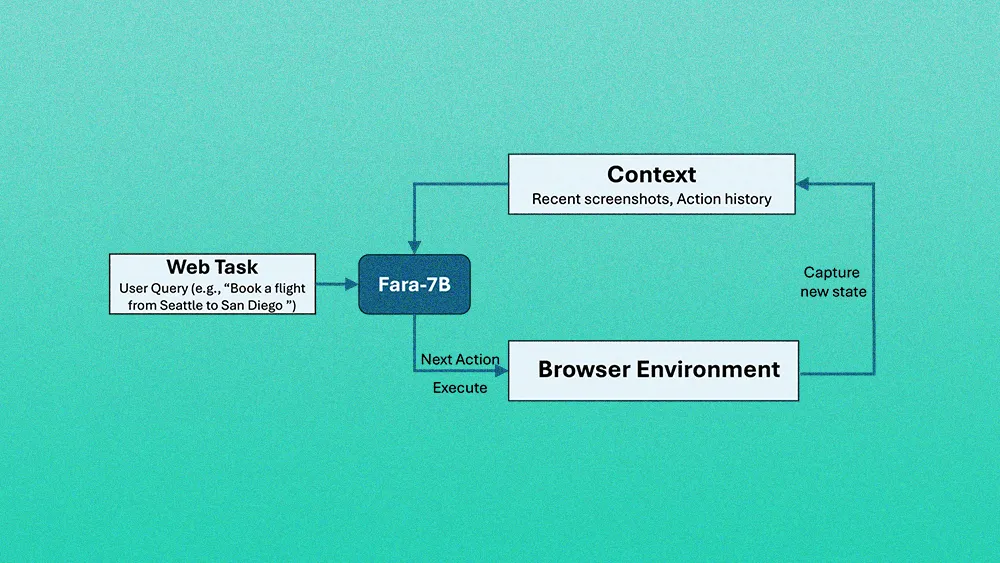
Microsoft has released Fara-7B, a 7-billion-parameter agentic AI designed to operate directly from a user's PC. The model automates web tasks by controlling the mouse and keyboard, with its local-first approach intended to boost user privacy by keeping data off the cloud.
Taught to see: Unlike assistants that need to read a website's code, Fara-7B operates by visually perceiving screenshots, allowing it to navigate sites like a human. To train it, Microsoft built a synthetic data engine called FaraGen, which, according to an accompanying research paper, generates millions of verified action steps across tens of thousands of live websites.
Punches above its weight: The result is a compact model that reportedly holds its own against bigger systems. On industry benchmarks, Fara-7B is competitive with larger models like GPT-4o and tops others in its own weight class, all while completing tasks at a fraction of the cost.
Handle with care: But don't fire your assistant just yet. Microsoft is upfront that Fara-7B can still make mistakes or "hallucinate," and demos showed it working slower than a human. The company is releasing it as an experimental, open-weight model and advises users to stick to sandboxed environments for now.
Fara-7B marks a concrete step toward capable, on-device AI agents that can automate daily digital chores. However, its acknowledged limitations show that the path to a fully autonomous, reliable AI assistant is still a long one. The model is being integrated with Magentic-UI, a research prototype from Microsoft's AI Frontiers group where developers can test its capabilities. It builds on the company's broader push into on-device AI, following its release of previous small models like Phi.