

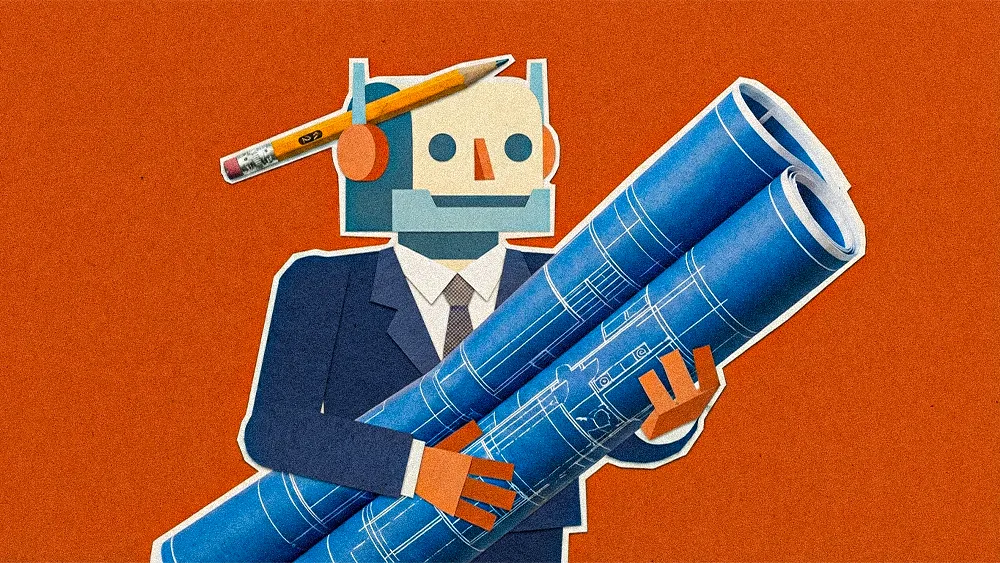
Decorators are bolting AI onto broken processes, and that’s how organizations become hollow. The winners will be the rebuilders. They are the ones willing to redesign their business from the ground up for a world where AI agents are embedded into every workflow.
 Damien CummingsChief of Digital Strategy & Leadership @ National University of Singapore
Many enterprises focus on surface-level efficiencies over deep, structural change as they adopt AI. The consequence is the rise of “hollow organizations,” companies that appear leaner but are fundamentally brittle. AI adoption accelerates as headcount shrinks without strategic clarity, while bottom line impact remains elusive.
Damien Cummings is the Chief of Digital Strategy & Leadership at the National University of Singapore (NUS-ISS). A PhD researcher studying the "AI sociotechnical trap," Cummings brings three decades of experience leading transformations at global firms like McKinsey, Dell, Samsung, and Standard Chartered, which have generated over US$1.5B in growth. He believes leaders are facing a fundamental choice that will determine their company's fate.
"Decorators are bolting AI onto broken processes, and that’s how organizations become hollow. The winners will be the rebuilders. They are the ones willing to redesign their business from the ground up for a world where AI agents are embedded into every workflow," Cummings says. The distinction plays out in how organizations approach headcount. The decorator's instinct is to cut first, then figure out workflow redesign later, if at all.
Cummings traces the pattern to a misinterpreted signal from Big Tech. During the pandemic, tech giants doubled their headcount, only to reverse course to fund a speculative, multi-hundred-billion-dollar race for Artificial General Intelligence (AGI). Banks and professional services firms followed suit with cuts of their own, often chasing cost savings without a clear strategy for creating new value, even when AI business models remain hazy and uncertain.
Hush-hush headcount: The hidden driver of this approach is rarely discussed openly in boardrooms or town halls. "There are two conversations happening. The public one is about personal productivity tools like ChatGPT. But at a company level, the discussion stops there. The secret, much harsher conversation is about using AI agents and improved workflows to justify laying off large chunks of people," Cummings explains.
From pyramid to pancake: This mindset produces a distinct set of symptoms: flattened hierarchies, disconnected pilots, and chaotic AI sprawl. Only 6% of companies truly trust AI agents, and over 40% of agentic AI projects are expected to be scrapped by 2027. "Hollow organizations are turning their pyramids into pancakes by flattening the middle management layer. This decouples strategy from execution. This creates holes throughout the organization like Swiss cheese, making the company brittle and causing risk to accrue," he notes.
A blueprint for brittleness: In their rush for frictionless efficiency, companies tear down the very human guardrails that once protected them from systemic risk. When you remove friction, you often remove scrutiny. The risk of this hollowing-out process is not abstract, there is a well-documented precedent for what happens when organizations prioritize cost-cutting over capability. "Look at Boeing and the 737 MAX. They were an organization that had been cutting for years and had lost capability. That hollowing out led directly to tragic plane crashes, a damaged brand, and people losing their lives. I hope we don't see the AI-driven version of the Boeing 737, but the scale of that failure could be orders of magnitude larger as almost every company starts to adopt AI," Cummings warns.
The solution is rooted in a new philosophy of accountability. As workforces change to include both human and digital employees, new governance models are required. This principle is at the heart of the world’s first agentic AI framework from Singapore, which Cummings calls the "intentional organization," or "agentic organization." The focus is on a ground-up workflow redesign, recognizing that the next wave of enterprise AI will be won inside the workflow, through strong AI governance.
The human failsafe: This new governance model redefines the line manager's role as the ultimate authority over AI systems. "In a properly governed organization, the line manager becomes the 'big red button.' They are the one who approves the AI's actions and has the authority to shut down systems when things go wrong. That individual is personally accountable. Right now, too many people are passing the buck. They tend to blame the tech company, the organization, or the regulator. But true governance demands that a specific human takes responsibility," Cummings argues.
People, not platforms: Anyone can build an agent with minimal training, but the real barrier is non-technical: making the bold decision to rebuild workflows from the ground up rather than decorate existing processes. "The problem was never the technology, it's always the people. The technology is commoditized. Anyone can build an agent or use these tools with minimal training. The real challenge is the hidden, non-tech part: making the bold decision to rebuild. A leader who chooses to be a decorator is probably doomed to create a hollow organization," he maintains.
Both the decorator and the rebuilder create smaller organizations, but they arrive at fundamentally different destinations. The decorator’s path leads to hollow, brittle companies. Rebuilders create enterprises that are not just smaller and faster, but fundamentally more resilient. The prize isn't just survival, it's a significant, sustainable competitive advantage. "They are going to be streaking ahead of their competition, leading new markets, and pulling away from all the other companies around them," Cummings concludes.