
The organizational structures are still in the industrial and service age, not in the AI age. The capability is there, but there's no authority there, and that's the security problem.
 Jorg HuserCTO and Co-Founder @ Big Barn Group
The biggest AI spenders in the world are investing over $800 billion this year in data centers and infrastructure. Many of those same companies are laying off experienced workers to fund the buildout. The result is organizations with enormous AI capability and shrinking human capacity to direct it. The systems are fast. The question is whether anyone left in the building knows where they should be pointed.
Jorg Huser is CTO and Co-Founder of Big Barn Group, where he created the MyAIRole framework for mapping human talent to AI collaboration roles. Before founding Big Barn Group, he spent nearly five years as a Principal Security Architect at AWS, where he built a GenAI-powered engine that influenced a $1B pipeline.
"Technology has overwhelmed us. The whole AI wave came so fast that we're not really prepared for it. The organizational structures are still in the industrial and service age, not in the AI age. The capability is there, but there's no authority there, and that's the security problem," says Huser.
Speed without direction is a liability
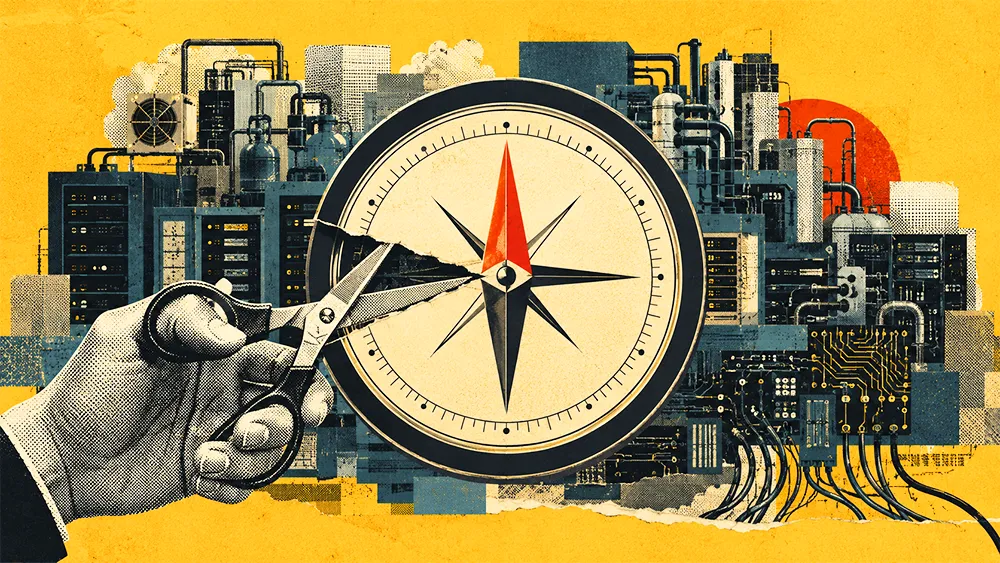
Huser frames the core problem with a metaphor he returns to throughout the conversation: if you travel at the speed of light, you need to get the direction right. Most enterprises have the speed. They do not have the direction.
"If AI gets autonomous and does stuff by itself, you have safety and security concerns," Huser says. "Who has accountability for the business outcome and the risks? That is not clear." When context is incomplete, outputs diverge fast. "Most humans use AI like they used Google. But AI needs context, preferences, system prompts. Little information that's not there can create a totally different direction."
Huser uses a blunt analogy. "One guy has 20 Ferraris. They're super fast. But you're just one person who can determine the direction and the speed and where it's going." Companies are buying more Ferraris while reducing the number of drivers. "They're laying off the well-paid, experienced people they actually need to define the direction, and then the few people left are going to be overwhelmed."
The generalist trap
A growing consensus in the training market says everyone needs to become an AI generalist. Huser disagrees.
"A lot of people say you need to become an AI generalist because the specialist stuff, AI will take care of," Huser says. "I don't agree. If you can travel at the speed of light, you need to be a specialist in the moon or Mars." The generalist model works for experimentation. At production scale, domain expertise combined with AI fluency is what keeps execution from drifting.
"Companies whitewash the entire organization with forced trainings that are completely not relevant to the job," Huser says. "Most education tests memory, which is not needed with AI. What you really need is to test dynamic intelligence, which most universities don't do."
The MyAIRole framework
Huser's practical answer is a role-mapping assessment that identifies innate strengths for working with AI, then aligns teams around those strengths.
The framework maps 10 AI collaboration roles across value creation (Opportunity Scout, Innovator, Domain Expert), execution (Orchestrator, Solution Builder, Momentum Driver), and value protection (Quality Guardian, Truth Assessor, Harmonizer). Each maps to innate strengths rather than job titles, and most people carry multiple strong roles.
"You don't need to start from square one," Huser says. "Use an existing team, do the assessment, figure out who has what roles, and line them up incrementally. But it starts with awareness." Most people cannot intuitively identify their AI collaboration strengths, which is why structured assessment matters before training dollars are spent.
The break-even is coming, but not yet
Huser analyzed data from the World Economic Forum, Department of Labor, and consulting firms to estimate when AI will create more jobs than it destroys. The answer: not yet. "Right now we are in a phase where companies are laying off and investing everything in AI technical infrastructure," he says. "But the data center buildout is not going to happen overnight. Energy is five to eight years out for nuclear. So until you have that infrastructure, companies are going to keep laying off."
The imbalance creates the accountability vacuum Huser warns about: fewer experienced people steering more powerful systems, generic training replacing domain-specific judgment, and organizations structured for the service age trying to operate in the AI age. "The whole circle of the economy doesn't work if AI is buying on Amazon and there is no consumer," Huser says. "You need humans to do the direction. CEOs who believe you just need AI and no humans are going to find out otherwise."