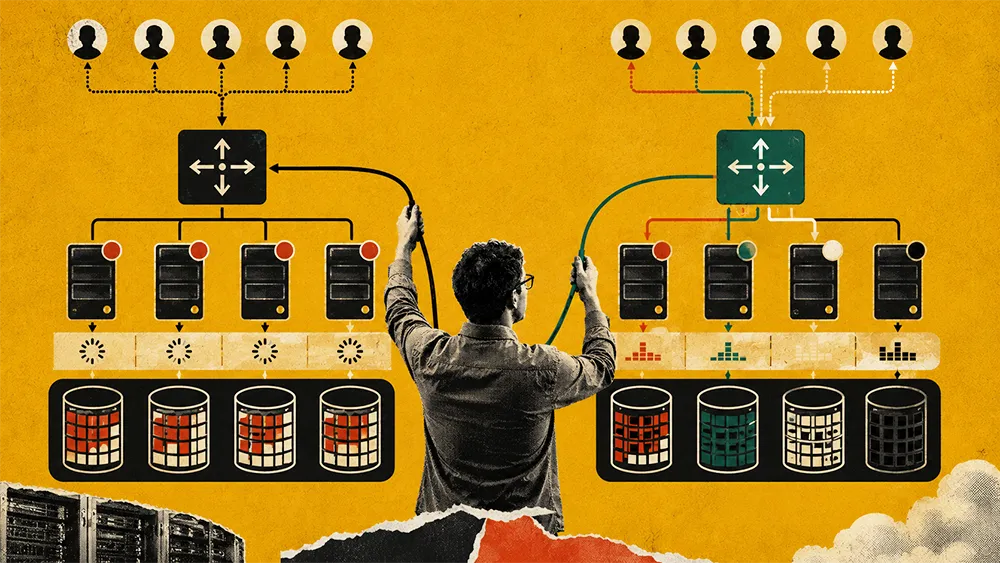


The instinct when enterprise AI underperforms is to change the model. Compare the frontier systems, read the leaderboards, and standardize on whichever one scores highest. But once the top models are close to interchangeable, reliability stops being a model property and becomes a data one. What decides whether an agent gives a defensible answer is the layer between the model and the organization's information: how context is managed and reinjected, whether the enterprise's own vocabulary resolves to something machine-readable, and which data each agent is permitted to touch. That layer is where AI meets the data it's supposed to reason over, and it's where most enterprise deployments break.
Kamal Singh is an AI and analytics leader in the pharmaceutical industry whose work spans medical analytics and AI development operations across regulated enterprise environments. Singh works on the part of the stack that benchmark conversations often skip: the infrastructure that governs what an agent actually knows when it answers.
"Models themselves are inherently stateless. Even with the large context window, it doesn't remember what it said from turn to turn. We just kind of cheat the system by injecting that context in each time," Singh explains. Everything that makes the answer reliable, he says, must be built into the data the model is handed rather than expected from the model itself.
The data layer decides the answer
Because the model itself holds no memory between turns, every answer is only as good as the information assembled and handed to it in the moment. Singh traces the field's progression from raw models, to prompts and skills, to tools and MCPs, to today's agents, and says the center of gravity has moved to a place most teams underinvest in.
"Agents themselves have gone from this LLM-plus-tools world into this holistic system design one where it's not just the LLM and the tool. You also have to consider how you manage context, how you manage the retry loop logic," he notes. On long, multi-step tasks, how that context is compressed and reconstructed drives more of the variance in output than the model underneath. Keeping the agent tied to the right data at each step, rather than letting it drift into whatever it half-remembers, is the actual engineering problem, and it's invisible to any leaderboard.
Vocabulary is a data-modeling problem
The most common failure is also the most mundane. Enterprise information is dense with internal shorthand, and an agent has no stable reference for what any of it means unless one is built.
"People love using acronyms. They have a ton of acronyms for every single thing," Singh says. He treats that as a data-modeling task rather than a prompting trick, building a ground-truth ontology that maps the organization's terms so an agent parsing a document or a request resolves them the same way every time. Without that mapping, one acronym resolves differently across two files and the agent's output inherits the contradiction. With it, the enterprise's language becomes structured data the system can reason against instead of a source of errors.
In regulated data, access control is the architecture
Accuracy is the low bar. In a regulated enterprise, the harder requirement is that the data layer itself enforce who is allowed to see what. A shared layer feeding multiple agents is where that gets dangerous.
"There are certain firewalls between a commercial function and a medical function and an R&D function," Singh says. His approach is to build a roles-based access system directly into the infrastructure around the agents, so that systems drawing on a common data layer can't carry one function's information into another. The separation must be architectural rather than a policy that assumes good behavior. When the data layer is shared, the access model is the only thing standing between efficient and non-compliant, which is why he treats it as a core component of the system rather than a setting applied after the fact.
Measure in leading and lagging terms
Structuring the data is half the work. Knowing whether it paid off is the other half, and Singh believes most teams measure the easy number and stop. His method, which he credits to the book Rewired, is to map a function end to end, break it into the problems worth solving, and attach a value case to each.
Some cases quantify cleanly. A workflow that saves ten teams two hours a week is real, though he's candid that raw time saved rarely persuades on its own. The number that matters more arrives later.
"There are leading and lagging indicators. The lagging ones become more apparent when you do this use case a year later and you realize, 'Hey, we made this deal that maybe if we had missed, we would have lost out on this much revenue,'" Singh explains. He brings both to leadership—the near-term figure that's easy to defend and the delayed business edge that's larger but harder to see. Some domains resolve faster than others. A team optimizing throughput sees the signal quickly, while a long-running process takes time to reveal its value at all.
Route each task to the model it needs
Do the data work well and the model choice stops being a high-stakes bet. When the underlying structure is sound and the layer around it stays model-agnostic, swapping one frontier system for another becomes a quick comparison rather than a migration, and the organization keeps its options open.
That flexibility carries a cost benefit too, because not every request needs the most expensive model. "If you build your custom harness, that can be an orchestration layer as well, where the main agent can actually smartly channel the different users and their requests to the appropriate cognitive load in terms of a model," Singh says. Investing in that orchestration layer costs more upfront than defaulting everything to a single system, but it lets the enterprise send each task to the model that fits it, priced accordingly, instead of paying premium rates for work that never required them.
The views and opinions expressed are those of Kamal Singh and do not represent the official policy or position of any organization.