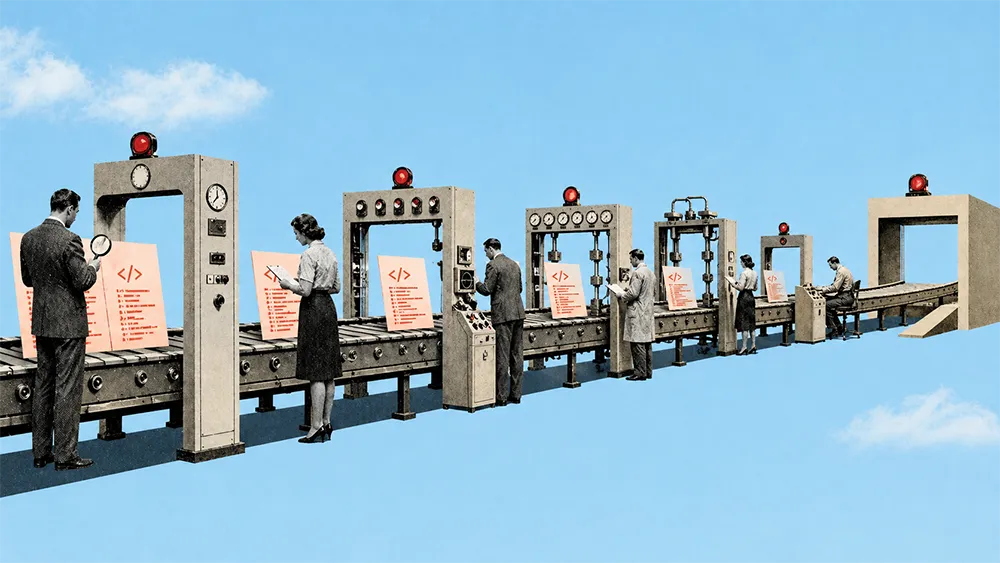


The fundamental failure of many large organizations is putting people who are built for control—the planners, the risk-averse—in charge of experiments. Unfortunately, those experiments are guaranteed to die a costly death.
 Colin ZeeGlobal Head of CTO @ HSBC
For all the investment and enthusiasm, most corporate AI projects still fail. But the reason is not a lack of tech. Instead, it's endless governance and bureaucracy that stifle momentum. In fact, "work about work" consumes up to about 60% of an employee's time today.
To get a leader's take, we spoke with Colin Zee, Global Head of CTO DevOps GenAI programs at HSBC, a financial services firm. Having directed the world's largest enterprise rollout of GitHub Copilot and advised the UK government on AI implementation, Zee's credibility comes from years of demonstrable results. But his approach is also informed by a long career at other top-tier financial institutions like Goldman Sachs and Standard Chartered Bank. For Zee, the root of the problem is a mismatch of task and talent.
"The fundamental failure of many large organizations is putting people who are built for control—the planners, the risk-averse—in charge of experiments. Unfortunately, those experiments are guaranteed to die a costly death," Zee says.
An inconvenient truth: Most corporate initiatives fail because they ignore a simple reality, according to Zee. "I had this moment of clarity on one of my morning walks. I realized we forget that these developers have full-time day jobs. The idea that they're going to spend hours of their own time becoming experts in a new tool is a fantasy."
The master practitioner: For him, true potential is not unlocked by casual use but by deep expertise. "Look at someone like Miss Excel on YouTube. She does things with the software that make you ask, 'It can do what?' The chance of a normal user discovering those tricks on their own is basically zero. That's the power of a master practitioner."
Eventually, Zee's realization led to the "Catalyst" program, a protected space that deliberately circumvents standard corporate procedure. "At 69 years old, I have nothing left to prove in my career. That gives me the freedom to be decisive. I don't require universal buy-in to move forward. I will listen to your opinion. But as the program director, I have the professional right to ignore it, and I will."
The heat shield: The assertive stance was a strategy for Zee to create psychological safety. "My primary role became protecting my team from the organization. I told them, 'Here is our mission. If you get any political heat or pushback, you send it directly to me.' I acted as their heat shield, and 99% of the time, that heat never even reached my desk."
Bureaucracy busters: The rules of the program were simple: eliminate anything that got in the way of experts solving problems. "No managers. No account people. No business cases. No PowerPoints. You create a space where it's just the experts—propeller head talking to propeller head—focused on solving the problem."
A simple filter: "Instead of the standard 30-page questionnaire that no one can fill out, I created a simple five-question template that takes 15 minutes to complete. When the PMO saw it, they nearly had a heart attack, but it got us exactly what we needed."
The results were immediate. For Zee, what the method proved was that the barrier was not the tool but the team's knowledge of how to use it.
Ridiculous ROI: "One team saw a 90% productivity gain. We tackled a legacy COBOL system and saved 11,500 developer days after less than two weeks of work. The most stunning example was an API conversion that used to take three days. After just six hours of expert coaching, the team could do it in ten to twenty minutes. That saved them 6,500 developer days."
The bottom line: The program's impact was so significant that it validated Zee's counterintuitive approach at an industry level. "When I netted everything out, the ROI was 37x—a number that is off the scale for most corporate projects. The methodology was so successful that Microsoft stole it and rebranded it as 'Copilot Within'. The branding is terrible, but it's the ultimate validation."
But success depends less on technical knowledge and more on a leader's "power skills," Zee says. "You need someone who can speak the language of risk, who can confidently tell stakeholders, 'The residual risk here is minimal, and I'll ensure we adhere to all existing controls.' That's not a technical skill. It's a power skill. It’s about building trust. And that's what I do."
Breaking the mold: The irony, he notes, is that the very people often best equipped to drive change are usually the ones screened out by standardized corporate hiring processes. "It's ironic. I'm almost certain I would fail the standard psychometric tests that large organizations use for hiring today. What does it say about your system when it's designed to weed out the very people you need to drive change?"
According to Zee, the same logic applies to an even bigger problem: the bureaucratic overhead that consumes the modern workday. The potential return from tackling this administrative waste is massive, he explains. "My next mission is to attack that other 60% of wasted time. We're all focused on shiny new toys like GenAI, but if you could simply give a developer back two hours a week from meetings, the productivity gains would dwarf the benefits of any single tool."
A simple reframe: If fear of failure drives most corporate decisions, then Zee challenges that mindset. "In every meeting, the focus is on risk aversion. 'What could happen if this goes wrong?' I challenge leaders to ask the opposite question: 'What could happen if this goes right?' When you ask that, the room usually goes quiet for a moment, because it forces a completely different kind of thinking."
Just do the work: Framing the first step not as a massive commitment but as a small, inexpensive experiment, Zee gives leaders a simple way to begin. "This isn't about launching a massive, five-year transformation program. It's about giving something a try for four weeks. The cost is negligible, probably less than the budget for the fancy brochures you print once a year. In the grand scheme of things, it's nothing."
Instead of creating chaos, Zee deploys disruptors and stabilizers sequentially. In his experience, both skill sets are necessary to drive and then scale breakthroughs. "To be clear, you don't need a whole company of people like me. You just need a few. Your job as a leader is to put us in the right place to knock down the walls. Once the path is cleared, we move on, and you let the controllers come in to rebuild and stabilize. It's a two-step process."
In a culture where a single objection can halt a project, however, driving change requires courage. As Zee bluntly puts it, "It requires somebody to have the cojones to do it, basically." Sometimes, the most effective move is a small, tactical one, he concludes. For instance, whenever someone loops him into a pointless email chain, his response is simple: "Can you please loop me out?"